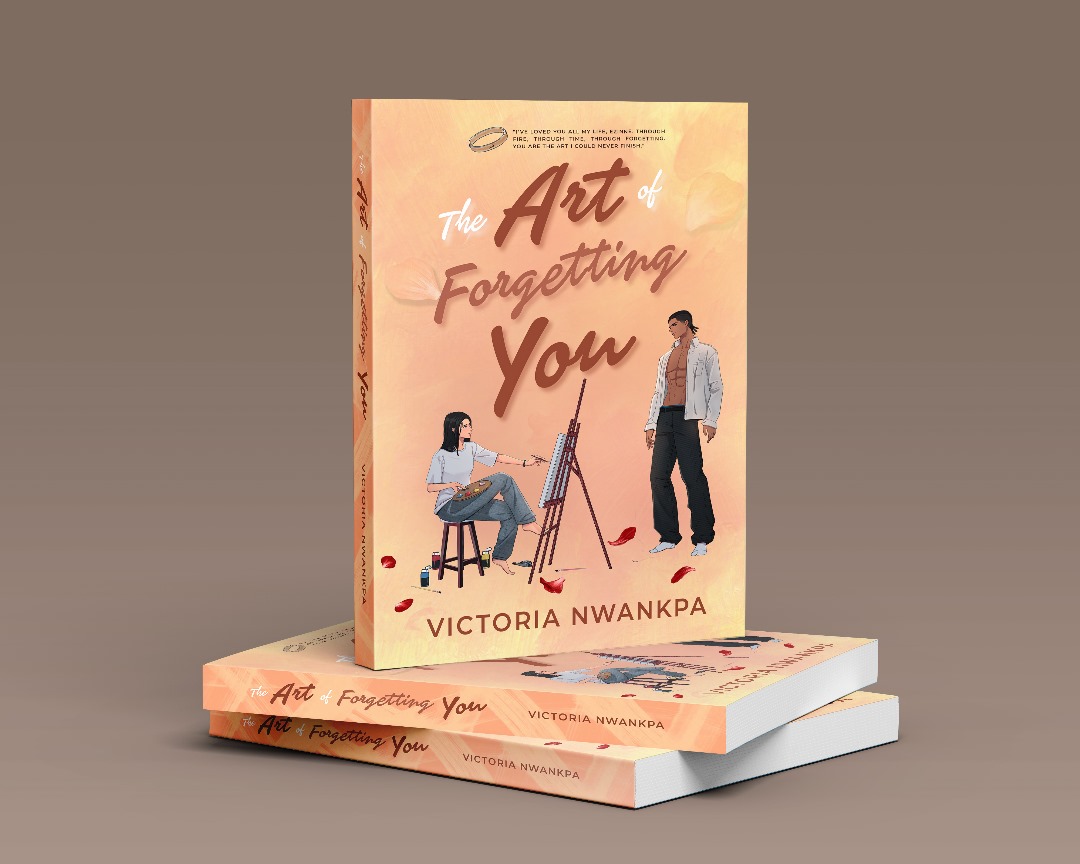
Title of Book: The Art of Forgetting You
Name of Author: Victoria Nwankpa
Genre: Romance Fiction
No. Pages: 120 (Inclusive of Author’s note)
Date of Production? 2025
ISBN:978-978-68-1247-2
Publishing House: Phoenix Award Books, PabPub. (www.pabpub.com)
Book Reviewer: Salamatu Sule
The Art of Forgetting You by Victoria Nwankpa is a romance novella that gradually becomes a psychological exploration of grief, trauma, memory, and identity. When Tega Idu, an attractive architect, meets the artist Ezine Okoro at the Lagos Art Exhibition, he is quickly drawn to her, and she feels she has known him all her life. Their romance unfolds like her art masterpiece. One dinner that blends with a jazz night seals their relationship. She becomes the art that will never end.
When their relationship seems heavenly and perfect, it takes one private exhibition invitation at the residence of the Daramolas to change everything. Ezine arrived at the mansion with Tega, who is clad in a suit and was soon all over being praised for her craft and skill. The Mansion is engulfed by fire; Ezine cannot find Tega. Her search takes a devastating turn and the unravelling of secrets buried beneath her for 15 years.
“A few minutes later, a shrill alarm pierced the air, and the Jazz music stopped at once.
Ezinne went still and turned towards the sound of the alarm.
The hall became dead quiet as everyone paused. The light dimmed twice before panic erupted like thunder in the hall.
Fire! A loud voice cried out.
There’s a fire!
Everybody, run!”
(Pg.32, TAOFY)
“Then, a strong hand gripped her shoulder.
Ezinne turned quickly, her hope flaring. Tega?
But it wasn’t him”
(Pg33, TAOFY)
Tega reappears weeks later after she had visited the police station and made several phone calls to some art collectors and bloggers who were present that night to no avail.
The question of whether Tega Idu existed in the world of Ezinne is at the core of this book; more intriguing is the appearance of Amara, who is an identical reflection of Ezinne. Readers will be amazed at this because the depth to which Victoria builds her characters is what makes this novella stand out.
Victoria Nwankpa’s most intriguing construction is not simply that Ezine has lost Tega; it is that, in surviving the trauma of losing him, she has also lost access to herself as Amara.
The distinction is crucial. Amara is not merely a former version of Ezine. She represents a self buried beneath a traumatic rupture—a past the mind has rendered inaccessible to survive. Ezinne becomes the reconstructed present, while Tega becomes the thread connecting that present to the life she can no longer consciously remember.
This makes Tega’s presence psychologically complex. He is dead, yet he continues to exist within her present. Her paintings give that internal presence form, allowing her to reconstruct him through art. But in reconstructing Tega, she is unknowingly reconstructing the pathway to herself.
This is where the novella’s treatment of dissociative amnesia becomes compelling. The central act of forgetting is not simply the forgetting of a lover; it is the fragmentation of autobiographical identity. Amara has disappeared into the trauma, and Ezine emerges as the self, capable of continuing to live. The return of Tega into her consciousness therefore becomes more than a return of memory. It becomes a confrontation with the buried self.
The deeper irony of the title is that The Art of Forgetting You may ultimately be about the impossibility of separating the memory of Tega from the memory of herself. To remember Tega is to approach the truth of Amara. To confront his death is to confront the trauma that created Ezinne. And to recover that buried history is, finally, to begin recovering the journey
Nwankpa consequently turns the canvas into more than a surface for remembering. Art becomes a psychological archive as represented by the sketchbook. It becomes a place where the fragments of a fractured past can begin to assemble themselves. Tega may be the person Ezinne believes she is trying to bring back to life, but the deeper revelation is that, through him, she is also bringing Amara back into consciousness.
In reality, many people live inside of the paradox and are unwilling to get out of it because of the fear of loss and, albeit, love.
Throughout the novel, the theme of fear, love, and loss is echoed, as these are the ingredients that fuel our mental well-being.
Readers of this book will have a dose of an unforgettable experience of human psychology and the unsettling story of Amara Okoro. More importantly, it is about how much we need to pay attention to our mental health, which has led many to suicide. In fact, this book is a gift to all those going through grief, to know that they can find themselves again.