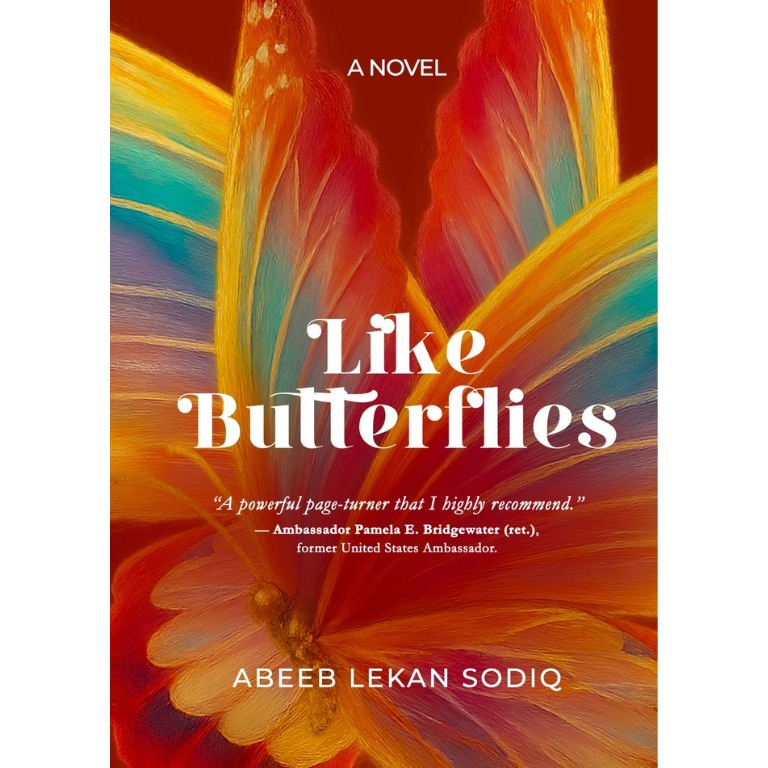
Book Title: Like Butterflies
Author: Abeeb Lekan Sodiq
Genre: Historical Fiction (Novel)
ISBN: 978-978-68-0230-5
Date of Publication: 2026
Cover Art: Nimot Odulaja
Publication Date: 2026
Page No. 217
Book Reviewer: Salamatu Sule
History often reminds us that our present is not our whole story. Everything about us began somewhere, and its fragments continue to live with us, sometimes, in ways we barely recognise. This is particularly true of historical fiction, where the past is not simply reconstructed but brought back to interrogate the present. Abeeb Lekan Sodiq’s Like Butterflies does precisely this. Set in the world of nineteenth-century Oyo-Ile, the novel takes us into a universe of royalty, power, ambition, class, slavery and betrayal. A world where the splendour of the palace exists alongside the brutality of a thriving trade of human lives.
When Adesewa, the daughter of Oba Adeloye and princess of Ilugun, goes missing from the palace, the story opens a darker passage into this world. We are introduced to Parcel Land a dreadful place with ruthless system through which slavery is commercialised and controlled by the dreaded Oosa and his gang.
What begins as the disappearance of a royal daughter therefore becomes an entry point into a larger story about power, vulnerability and the human cost of a society structured by hierarchy and commerce.
Captured and taken into Parcel Land, the girl whose identity is later revealed as Sisi is violently removed from the flamboyant ease of royal life and plunged into a darkening reality of oppression, where man is capable of extraordinary cruelty towards his fellow man. Yet Sodiq does not present Parcel Land as a space where suffering has erased social distinctions. Rather, he reveals that even within a world built on oppression, class survives, shaped by ambition, privilege and the desperate struggle for survival. In this way, the author shows how human beings can recreate hierarchies even within systems that have stripped them of their freedom.
Iya Temilola, one of my favourite characters in the novel, captures the essence of Parcel Land with a haunting simplicity:
“I cannot say much about it other than this is Parcel Land, and we are parcels, mere merchandise.” (p. 18, LB)
The statement captures the novel’s central transformation of the word parcel. What was once a trade associated with honour and status is transformed into a brutal system in which human beings themselves become commodities. Abeeb Lekan Sodiq draws a disturbing parallel between what was and what is: between the earlier meaning of parcel and the dark, dangerous reality of Parcel Land, where people are reduced to merchandise.
Oosa’s personal quest for vengeance adds another layer to this world. Convinced that the king has betrayed him, he vows to find the king’s only daughter and use her fate to send a message back to Ilugun. His rage turns Adesewa’s disappearance into something larger than a personal tragedy. Whether Oosa succeeds in finding her becomes one of the questions that keeps the reader turning the pages.
Sodiq demonstrates a firm command of characterisation and plot. His characters are not merely instruments for moving the story forward; their ambitions, resentments and choices continually generate conflict, deepen the tension and propel the narrative.
What makes Like Butterflies particularly compelling, however, is its movement across the historical space between the precolonial and colonial eras, when the slave trade had become an organised and brutal system of commerce. The novel’s historical setting consequently becomes a mirror through which contemporary society can be examined. The forms may have changed, but the impulse to exploit, dominate and dehumanise others has not disappeared.
Sisi articulates this uncomfortable truth when she observes:
“Look at Amoke, she is still healing from the whip, that could have been you or me.”
And then, with an even sharper indictment:
“We say the white man is the problem, but what we do to ourselves is beyond comprehension.” (p. 202, LB)
Here, Sodiq moves beyond a simple condemnation of the colonial slave trade. He turns the gaze inward, asking the reader to confront the uncomfortable reality that oppression can also be reproduced by those who have themselves experienced it.
The novel also explores the spirit of collectiveness and togetherness through Sisi’s revolution. Her struggle demonstrates that oppression is rarely defeated by the isolated individual; it requires people to recognise their shared condition and act collectively. Yet Sodiq is careful not to romanticise collective liberation. The novel also shows how individual betrayal can weaken a collective struggle and expose its members to powerlessness.
This is where the novel raises an interesting question about Marxism and the possibility of a new social order. If an oppressive system is dismantled, what guarantees that the new order will not reproduce the same structures of power in another form? Liberation may destroy one hierarchy, but ambition, privilege and the desire for authority can create another. In this sense, Like Butterflies seems to suggest that the problem is not only who possesses power, but what happens to people when they acquire it.
Adunni embodies this contradiction. She does not merely desire power; she desires the kind of power that establishes her authority and makes others fear her. Ironically, the Adunnis of this world—the very people who emerge from struggles against oppression—can become the new custodians of power. The oppressed can become the oppressor, and the revolution can reproduce the hierarchy it sought to dismantle.
This is perhaps one of the novel’s most unsettling questions: when the oppressed finally take power, do they transform the system, or simply change who sits at the top of it? The answer is not necessarily comfortable. Collective liberation may dethrone an oppressor, but without a transformation of the values and structures that produce domination, another Adunni may simply take the throne.
Like Butterflies, therefore, is not only a journey into a painful historical past; it is also an interrogation of the ways power, greed, class and exploitation continue to shape human relationships hierarchically.